 Nathalie participated in the European Week of Astronomy and Space Science 3 – 6 April 2018 (EWASS 2018) held in Liverpool. She made a very interesting and successful presentation at one of the sessions. The EWASS is the annual meeting of the European Astronomical Society (EAS). This year there were some 1400 participants.
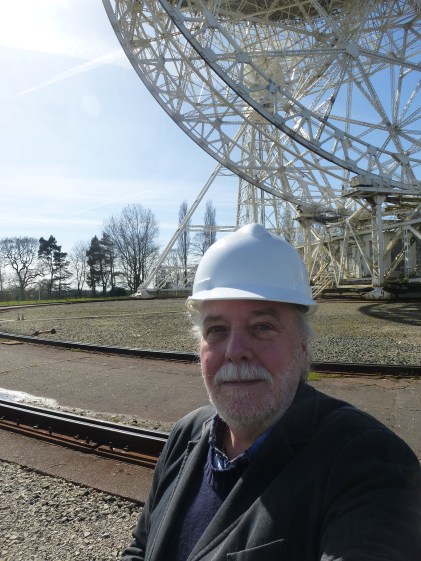
Nathalie invited me to participate in some of the activities organised during the event. I participated in a one day visit of the Jodrell Bank Observatory.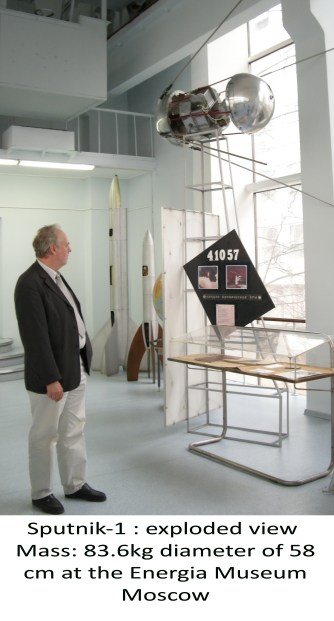
I learned of the existence of Jodrell Bank when in October 1957 Jodrell Bank’s telescope detected the world first artificial satellite; Sputnik. Later I read that in reality it was Sputnik’s launch rocket that was tracked by the telescope and not the satellite itself. I remember very well the 4 October 1957 when Sputnik was launched and when during the night we observed the night sky hoping to see Sputnik.
There is thus for me a sentimental attachment to Jodrell Bank!
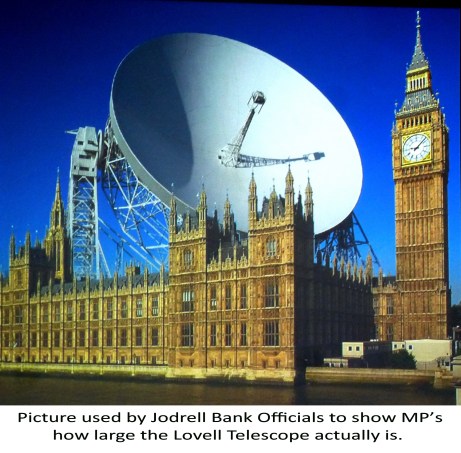 The telescope was also used to send commands to satellites such as US Pioneer 5 satellite launched in 1960. Notwithstanding the Cold War the Soviet Union asked Jodrell Bank in February 1966 to track the USSR moon lander Luna 9 and recorded the transmission of photographs from the moon’s surface.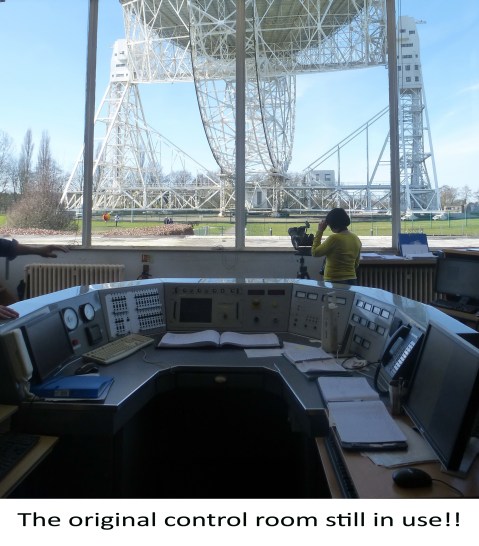

More recently Jodrell Bank Telescopes made observations of pulsars; quasars and gravitational lenses (including the detection of the first gravitational lens and the first Einstein ring).The telescope has also been used for SETI (“search for extraterrestrial intelligence”) observations.
 Experiences I wish to Share